A top OSHA and worker safety blog from industry veterans. Read the latest OSHA news and find critical safety tips to keep your workers safe. Check Often!
OSHA News & Workplace Safety Blog
-

15 Tips to Become an Employee Safety Leader
Taking the Lead on Safety – What’s Next?
-
4 Steps to Communicate HAZCOM Safety Clearly
Last year, one of the largest automotive glass suppliers in the world — a publicly-traded company that supplies materials to all the major automobile manufacturers — appeared to be on top of the world. The company was worth tens of billions of dollars, with manufacturing facilities all over the world. A documentarian even made a major motion picture about the company.
-

100 Employee Safety Actions to be a Zero-Hero!
Imagine you’re a worker facing numerous hazards every minute you are at work.
-

OSHA National Fall Prevention Stand Down
What is a Safety Stand-Down? A Safety Stand-Down is a voluntary event at work, where employers and employees focus on safety. Any workplace can participate, even those not exposed to fall risks, by using the time to discuss other hazards, protective measures, and overall safety goals. It’s also a chance for workers to share safety concerns directly with management.
-
Fall Protection Systems Help Prevent Construction Fatalities
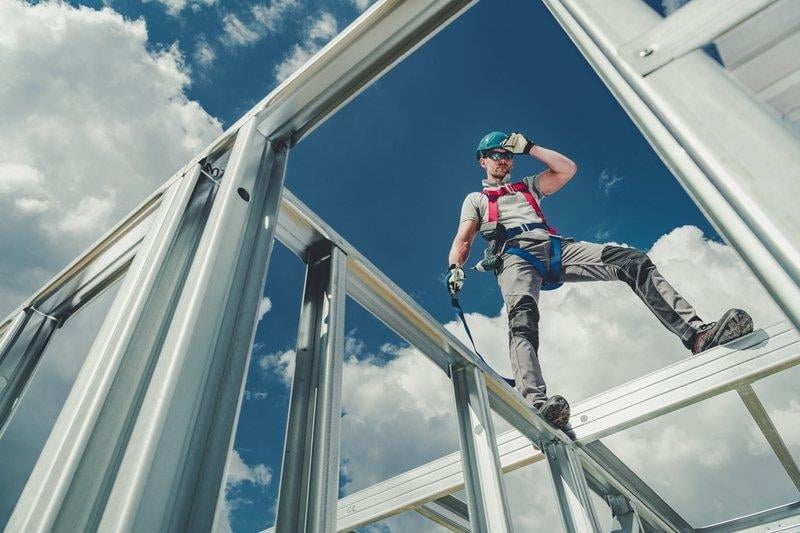
Fall Protection Systems can prevent nearly 40% of construction industry fatalities! A Quick Guide to Reduce Construction Fall Accidents with Fall Protection Systems Falls are the leading cause of construction industry fatalities and injuries and are the biggest component of what OSHA calls the ‘Focus Four’ accidents. Falls are such an important issue for OSHA that each year they hold a ‘National Safety Stand Down’ to increase awareness of fall accidents and prevent them. We must always ensure we utilize engineering controls to remove any risk from a work site, but there will still be some hazards that remain.
-

How to Prevent OSHA’s ‘Focus Four’ Accidents
Good people took huge risks to build the place you are sitting in right now. Workers in the construction industry build the world around us. We tend to take for granted the buildings and infrastructure that these hard-working individuals construct and maintain. It is important to acknowledge and show respect for these efforts that involved significant risks to employee health and safety. Ensuring that these workers are safe while on the job should be our top priority so that they can return home to their loved ones.
-

Combustible Dust Hazards Targeted for OSHA Inspections
A revision to an existing National Emphasis Program directs OSHA to increase jobsite inspections for combustible dust in specific industries. Take necessary action now to avoid hazards and pass an inspection without being cited and publicly known as an OSHA compliance violator. Here is a great collection of OSHA resources to reference about Combustible Dust: An OSHA resource page with many useful links. A simple OSHA guide to combustible dusts you can view. A very technical OSHA deep dive. An existing Nationwide Enforcement Program focuses on combustible dust hazards and was revised on January 30, 2023. The National Emphasis Program, starting in 2008, focused OSHA inspections on the unique and often hidden hazard presented by combustible dust (source). OSHA has cited the following statistics for this: The U.S. Chemical Safety and Hazard Investigation Board (CSB) identified 281 combustible dust incidents between 1980 and 2005 that led to the deaths of 119 workers, injured 718, and extensively damaged numerous industrial facilities. What is Combustible Dust? OSHA defines combustible dusts as “fine particles that present an explosion hazard when suspended in air under certain conditions” (source). Examples of combustible dusts include many types of materials that most people would never thing of combustion: metal dust such as aluminum, magnesium and some forms of iron wood dust coal and other carbon dusts, including carbon black plastic dust, phenolic resins, and additives rubber dust biosolids other organic dust, such as sugar, flour, paper, soap, and dried blood certain textile materials To make matters worse, many Safety Data Sheets don’t fully account for the combustibility of materials. OSHA infers: 41% of the SDSs reviewed by the CSB did not warn users about potential explosion hazards. Of the remaining 59% of SDSs sampled, most of the information was either not stated in a place or manner clearly recognized by workers or was not specific to hazards related to combustible dusts. Employers need to proactively assess the workplace conditions that lead to combustible dust hazards. There are 5 conditions for a dust explosion to happen and is summarized by the ‘dust explosion pentagon’ (source). The first three elements are those needed for a fire, i.e., the familiar “fire triangle”: 1. Combustible dust (fuel); 2. Ignition source (heat); and, 3. Oxygen in air (oxidizer). An additional two elements must be present for a combustible dust explosion: 4. Dispersion of dust particles in sufficient quantity and concentration; and, 5. Confinement of the dust cloud. Note, if one of the above five elements is missing, an explosion cannot occur! New Industries are deemed high-risk and will see increased inspections. The following North American Industry Classification System (NAICS) codes have been added to the NEP: 311812 – Commercial Bakeries 325910 – Printing Ink Manufacturing 321912 – Cut Stock, Resawing Lumber, and Planing 316110 – Leather and Hide Tanning and Finishing 321214 – Truss Manufacturing 424510 – Grain and Field Bean Merchant Wholesalers What exactly is an “OSHA Inspection”? An OSHA inspection of your jobsite can occur for many reasons such as employee complaints or pre-programmed enforcement of key initiatives by OSHA such as this National Emphasis Program for Combustible Dust. There are essentially three parts to an inspection: the opening conference, a walk-around of the jobsite, and a closing conference. Please note, this doesn’t necessarily finish within 1-day as it could take many days or months, depending on your business’ complexity, locations, and issues they find. OSHA has up to 6 months to issue citations. At the opening conference, the OSHA inspector will first present their credentials that includes their photograph and serial. The compliance officer will then explain why OSHA selected the workplace for an inspection and the scope of the inspection. Next, they will request documentation related to workplace safety such as: Required OSHA Records like Form 300 listing workplace injuries or illnesses Written Safety Programs Safety & Health Training Logs SDS Logs Preventive Maintenance Records And more! With documentation in hand, the OSHA inspector will then conduct a walk-around of the work site. The compliance officer is looking for the specific hazards that triggered the inspection but can and will expand the inspection for any hazard they find. What might start from a combustible dust related inspection because you run a saw mill can turn into inspecting the last time you conducted maintenance on your forklift because it looks quite run-down! The inspector may also bring testing equipment with them to identify hazards related to air quality or noise. The inspector will very likely interview employees as part of the inspection process, and employees have the right to talk privately and confidentially to the officer. After the in-depth walk-around of your facility or jobsite, the inspector is required to have a closing conference with both management and employees. The inspector will discuss the “apparent violations” and ways to correct these. You will be given deadlines and possible indications of fines. Note, your employees have specific rights that the inspector will discuss with them or their representative. OSHA must issue citations against your company within six months of the occurrence of the initial inspection. Also note, OSHA never fines employees for violating their duties under Section 5(B) of the OSH Act (source). Instead, citations are always about the employer providing safe working conditions. This leaves a lot of room for interpretation and you are required to think deeply and foresee employee safety risks. Inspections and Citations are publicly accessible information! One of the most important things to note about being cited by OSHA is that it is public information. Your business and the information related to the inspection, such as citations and penalty amounts, will be put on OSHA’s website. This will remain up on the web indefinitely. Obviously, the harm to a business’ reputation could be severe especially if you do business for large companies or the government. Are you curious if your company has an inspection history prior from you being hired? Check out the database and look up your company’s information. What should you do to pass a Combustible Dust related OSHA inspection? There are a few critical steps here: First, reduce your chance of getting inspected by taking employee safety seriously and treat your workers with the respect and care we all deserve. We say this because even with the NEP on combustible dust, only 40% of inspections are pre-planned by OSHA. Most OSHA inspections are due to employee complaints, an injury or death, or because other organizations or even individuals outside the company refer a complaint to OSHA. (source). Second, develop and implement a combustible dust safety program in place. Remember, you must take into consideration all situations a worker may be exposed to combustible dust. Next, having a combustible dust safety program only goes so far if employees are not properly trained. Review OSHA’s training requirements for employees’ initial assignment to the job, as well as annual and periodic training. Everything is fair game once an OSHA compliance officer opens an investigation. If you are targeted for a combustible dust inspection, you can still be cited for any hazard they find (source). In summary, have your company’s safety programs in-place, up-to-date, and be thorough. Most importantly, train your workers on all applicable OSHA standards called out in your safety program! What should I do if I am not OSHA-compliant? If your company is too small to have a dedicated Safety Officer or they have too much on their plate, it’s time to consider outside help. The first thing to know about using third-party safety consulting services is understanding the true level of service they actually provide. Many companies will ‘write’ you a safety program by placing your company name on a template they already have and charging you a high price. Does this get you compliant with OSHA? Maybe… temporarily… Does it help keep your workers safe from the actual hazards your company faces? Probably not. It’s checking off the boxes on a list on one of the most important aspects of running a business… people’s safety and well-being! Being safe requires real work. There are no shortcuts. We at Lancaster Safety Consulting Inc. are experienced professionals who help our clients get and stay OSHA-compliant. We dig deep into your business to understand what your workers do each day. We have custom written thousands of safety programs and have trained ten of thousands of workers in courses such as OSHA 10 Hour, Fall Protection, Confined Space, Combustible Dust, and dozens of more topics. We can come to you at your facility to train your workers all at once or we can set you up with your very own Online OSHA Training Center for many training topics. We are real people who put in the work to help consult you on the best decisions to make your workplace safe and keep employees happy! If you need help, just send us a message or call us at (724) 776-1003.
-

OSHA Form 300A Must Be Posted February 1st through April 30th
OSHA requires many types of recordkeeping for most businesses with more than 10 employees on average during a calendar year.
-

Occupational Safety Quotes & Inspiration
Stale Safety Culture Does your safety program feel stale? If you can relate to this, we want you to know that you are not alone! Your company might have set off on your safety journey and made some serious strides to achieving an outstanding safety program. After a few years though, that momentum tends to slow down. This can leave business owners and safety professionals at a loss for what to do next. How do we continue to get people involved in the safety program? What do we do when our safety program feels like stale bread? Is there anything we can do to “mix it up” when it comes to safety?
-

Fire Prevention Week is October 8-14, 2023
Subscribe
-

Safe + Sound Week: August 11-17, 2025