More on Safety & OSHA Compliance
Good people took huge risks to build the place you are sitting in right now.
Workers in the construction industry build the world around us. We tend to take for granted the buildings and infrastructure that these hard-working individuals construct and maintain. It is important to acknowledge and show respect for these efforts that involved significant risks to employee health and safety. Ensuring that these workers are safe while on the job should be our top priority so that they can return home to their loved ones.
Should the workers who installed the roof on your home to be protected from falls?
Should the workers digging deep trenches to install sewer lines to your home or office to be protected from cave-ins?
Should the team of workers installing fresh, smooth roads to be well-trained and protected from the monstrously large machines rumbling precariously close to their intense and coordinated dance of labor?
As a leader in your organization, you think about these difficult situations each day and do what is necessary to keep your workers safe. However, that doesn’t mean that employee safety is easy. It’s a complicated and ongoing journey that never ends. Thankfully, we have the Occupational Safety and Health Administration (OSHA) to help reduce the number of accidents and fatalities that occur in the workplace. We think of OSHA as the referee who ensures all organizations take the necessary steps to keep their employees safe on the job. To help you address the safety challenges inherent in the construction industry, we created this step-by-step guide to prevent “OSHA’s Focus Four” accidents.
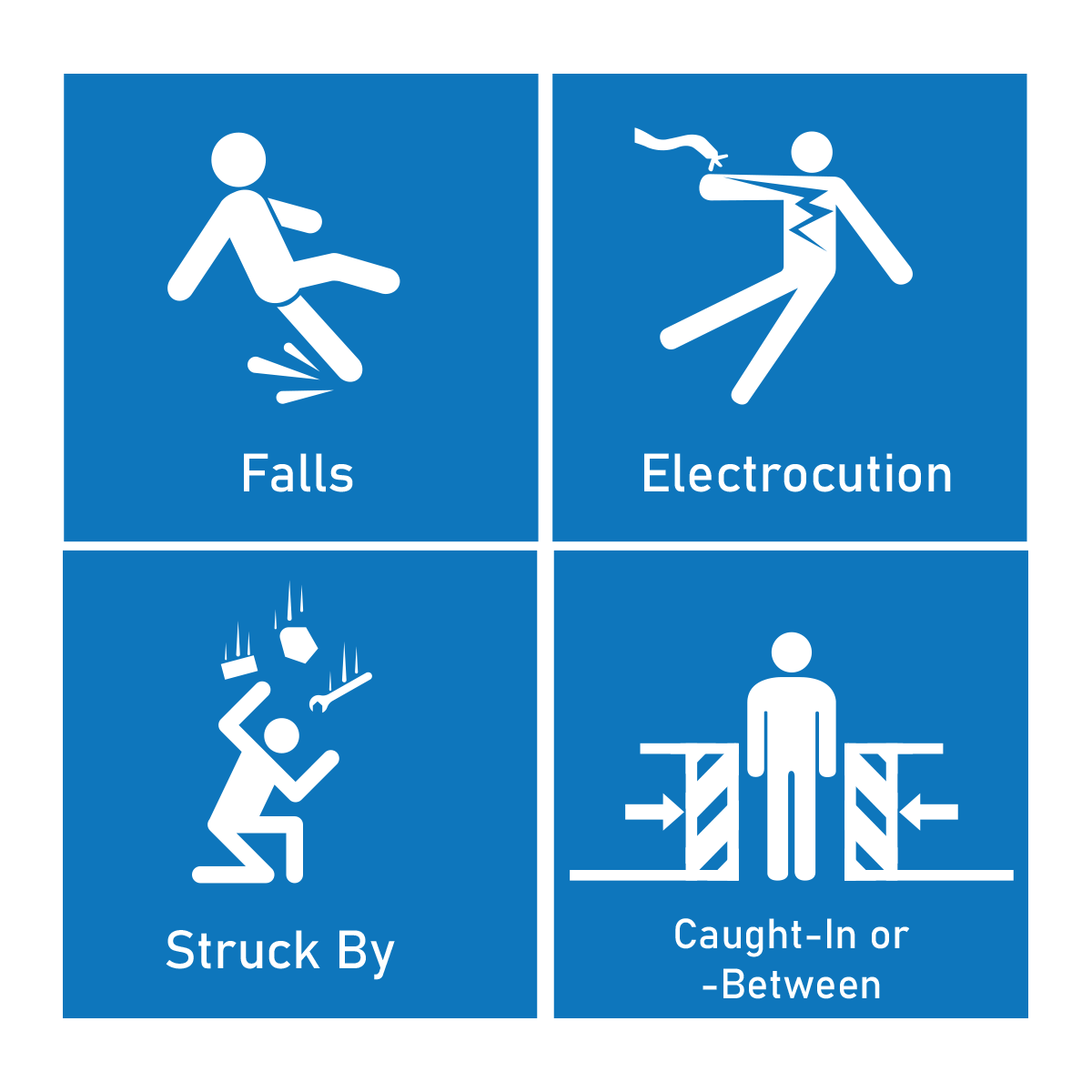
OSHA’s “Focus Four” are the most common causes of fatalities and serious injuries in the construction industry. They include falls, struck-by accidents, caught-in or between incidents, and electric shock. Collectively, the Focus Four account for 60% of all accidents in the construction industry.
OSHA rightfully takes these accidents seriously, and the Focus Four are 85% of all OSHA citations and 90% of all fine amounts! In addition to these four types of accidents, OSHA also focuses on other hazards that are common in the construction industry, such as silica exposure and heat stress.
Follow this 5-step framework to prevent Focus Four accidents.
We believe in going beyond the standard to ensure every worker comes home safely each day and recommend a comprehensive safety program to prevent all hazards, including OSHA’s Focus Four:
- Conduct a safety evaluation: You can’t prevent what you don’t know. Conducting a hazard assessment is the first step toward workplace safety. It is an essential step in identifying potential hazards and developing a plan to control them. Use the collective knowledge of your team and consider hiring a third-party safety consultant like Lancaster Safety to fully identify all risks. No one knows everything and this is a team effort!
- Implement engineering controls: Work smarter not harder. The primary action for a safe work environment is to simply avoid the risk completely through engineering controls. These controls are physical changes made to the work environment to reduce or eliminate hazards. Examples of engineering controls include guardrails to prevent falls, barriers to protect workers from moving vehicles or equipment, and equipment guards to prevent caught-in or between accidents. Every risk should be evaluated if it can be removed, but many times risks will remain.
- Conduct regular inspections: Similar to controls, conducting regular inspections of equipment and work areas can help identify potential hazards before they can cause an accident. Make sure that equipment is maintained and inspected regularly, and that work areas are kept clean and free of hazards.
- Train workers: Knowledge is power! Train workers on hazards they may encounter on the job and how to prevent them. Workers should be trained how to properly use ALL equipment they work with and how to follow safe work practices. While some of these practices may seem like common sense, not all are always instinctual, so train, train, and train some more. We know it can be difficult gathering all workers in one place, which is why we offer online or onsite OSHA training for hundreds of topics.
- Provide personal protective equipment (PPE): PPE is the last line of defense against workplace hazards that remain after process changes and engineering controls. You are required by OSHA to provide workers with appropriate PPE, such as fall protection harnesses, hard hats, and safety goggles.

Take these actions immediately to prevent the Focus Four accidents.
Falls are by far the leading cause of accidents in the construction industry, accounting for more 100,000 injuries per year and 150-200 deaths per year, or a third of all construction fatalities! Falls are entirely preventable and can occur from a variety of situations with the most common being scaffolds and roofs, but also includes ladders and other elevated surfaces. To prevent falls, OSHA requires employers to provide fall protection equipment, such as guardrails, safety nets, and personal fall arrest systems, and to ensure that employees are properly trained in the use of this equipment.
More specifically, you should take the following actions to prevent falls:
- Use proper fall protection equipment, such as guardrails, safety nets, and personal fall arrest systems.
- Check that all walking surfaces are constructed properly.
- Ensure that workers are trained in the use of fall protection equipment and the ABCs of fall arrest systems (Anchorage, Body Wear, and Connecting the Device).
- Inspect fall protection equipment regularly to ensure that it is in good condition and working properly. Check for tears, wear, dirt, grease, deformed parts, etc. Ensure the free-fall distance is no greater than 6 feet.
- Use warning signs and barricades to mark off areas where fall hazards exist.
- Provide workers with safe access to elevated work areas, such as ladders and scaffolds.
Electric shock occurs when workers encounter electrical current and represent 10% of construction fatalities. These accidents can be caused by a variety of factors, including contact with overhead power lines, live circuits in panels, poorly maintained cords and tools, improper use of electrical equipment, exposure to water or other conductive materials, and lightning strikes. To prevent electric shocks, OSHA requires employers to provide workers with electrical safety training, to properly ground electrical equipment, and to use lockout/tagout procedures to de-energize equipment before servicing or maintenance.
More specifically, you should take the following actions to prevent electric shocks:
- Use proper grounding procedures to prevent electrical current from flowing through metal parts of equipment and machinery. Use Ground Fault Circuit Interrupters in your circuits. Test equipment every three months and document it.
- Use appropriate personal protective equipment, such as rubber gloves and sleeves, to prevent electrical conduction to workers.
- Ensure that workers are trained in electrical safety procedures and the use of electrical equipment.
- Mark overhead power lines and other electrical hazards to ensure that workers are aware of their location. All equipment such as ladders, scaffolds, cranes, trucks, and forklifts MUST maintain a minimum of 10 foot clearance from a 50 kV exposure (add an additional 0.4in for every 50 kV).
- Use cords and wiring for its proper purpose. Don’t use indoor extension cords for outdoor work. Don’t fabricate extension cords with ROMEX® wire. Replace any cords with worn insulation or exposed wires.
Struck-by accidents occur when workers are hit by falling objects, vehicles, or equipment, and cause 9% of construction fatalities. These accidents can be caused by improper use of equipment, inadequate warning systems, or failure to properly secure loads. Most workers on foot are killed by being run-over by equipment, particularly while backing-up. Operators of equipment are most killed when the machines rolls-over, while many passengers are killed because they are not in a proper seat such as riding on fenders, steps, tailgates, etc.
To prevent struck-by accidents, OSHA requires employers to provide workers with hard hats, safety glasses, and other protective equipment, and more importantly adequate training in safe work practices.
- Use appropriate barriers, such as guardrails, to separate workers from vehicles and equipment.
- Don’t overload equipment.
- Inspect the operating environment, especially the ground, and if it can accommodate the equipment adequately.
- Ensure that vehicles and equipment are properly maintained and inspected regularly.
- Provide workers with high-visibility clothing and hard hats to increase their visibility and protect them from falling objects.
- Ensure that workers are properly trained in traffic control procedures and equipment operation. Also, ensure they are trained in proper rigging techniques.
- Provide workers with proper training in equipment use and safety procedures.
- Implement lockout/tagout procedures to ensure that equipment is properly de-energized before maintenance or repair work is performed.
- Use proper guarding to protect workers from moving machinery and equipment.
- Provide workers with adequate space to move around machinery and equipment.
- Ensure any excavation more than 5 feet deep is protected from collapse.
Caught-in or between accidents occur when workers are caught, crushed, or compressed between objects or equipment, and account for 3% of construction fatalities. These accidents can be caused by improper use of machinery, failure to follow safety procedures, trenching/excavation collapse, or inadequate guarding of equipment.
To prevent caught-in or between accidents, OSHA requires employers to provide workers with proper training, safety guards, and lockout/tagout procedures for hazardous energy sources.
- Provide workers with proper training in equipment use and safety procedures.
- Implement lockout/tagout procedures to ensure that equipment is properly de-energized before maintenance or repair work is performed.
- Use proper guarding to protect workers from moving machinery and equipment.
- Provide workers with adequate space to move around machinery and equipment.
- Ensure any excavation more than 5 feet deep is protected from collapse.
4 action items to prevent Focus Four accidents.
The steps above are a great start toward preventing OSHA’s Focus Four hazards but is by no means a complete list of every action you should undertake. Here’s your checklist of next steps to start now:

- Get your safety team together and identify those accountable for each action.
- Identify any gaps in expertise with your team and seek outside safety consultants if necessary.
- Have your team follow the 5-Step Framework above and build out your written safety program.
- Conduct a hazard assessment.
- Implement engineering controls.
- Conduct regular inspections.
- Train workers.
- Provide personal protective equipment (PPE).
- Implement a safety committee with representatives from all levels of your company and meet regularly.
Overwhelmed and not sure where to start?
If don’t have a dedicated safety team, need training, or simply want a professional safety consultant with years of experience across numerous businesses to provide additional expertise, Lancaster Safety Consulting Inc. can help your company. You can call us at (724) 776-1003 or fill out the form below.