More on Safety & OSHA Compliance
MultiEmployer Worksites and the Role of Staffing Agencies
WHY HIRE TEMP EMPLOYEES?
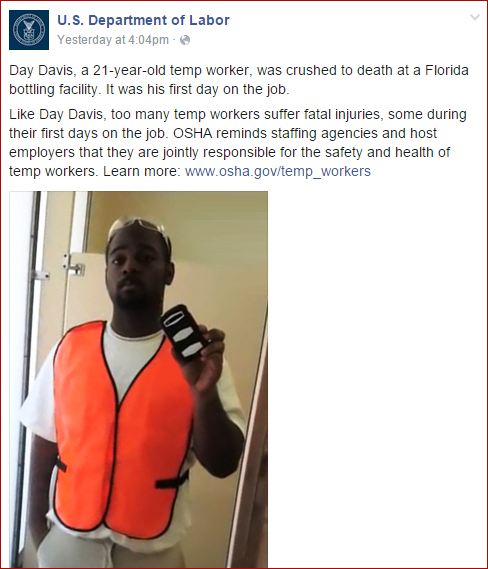
Over the past 30 years it has become increasingly common for businesses, particularly manufacturing, to hire employees on a temporary status. This accomplished several objectives. It assisted potential employers to ‘try out’ the employees to determine if they had the work ethic necessary to succeed, to allow their staffing requirements to flex in accordance with their workload, and to off load some of the liabilities associated with workers and the production process.
As this practice has become more common, it was probably inevitable that it would become unclear who was charged with the responsibility to manage and thus accept liability for these ‘temporary workers’. This discussion will attempt to clarify a few aspects of this interaction.
WHO IS RESPONSIBLE?
Much of the specific guidance for determining which employer is responsible for different aspects of employment arises out of the contract established between the host company and the staffing agency. An example of this delineation is who is responsible for day to day supervision and who carries and manages the workers’ compensation insurance required by law. However, it is critical to note that OSHA considers BOTH employers – host and the staffing agency – to be JOINTLY responsible for the safety of the temporary employee. The host employer is responsible for job assignments that are in keeping with the expected expertise level of the temporary employee, the working conditions, and emergency planning and intervention. They are also responsible, and this is critical, for the specific knowledge needed by the temporary employee. For example, lock out tag out programs can be taught by the staffing agency but the specific lock out points and the hazards associated with their particular machines regarding lock out procedures must be taught by the host company. If a supervisor from the staffing agency is taught this information then he can relay it to the temporary employees. However they must be taught the specific details by the host agency.
THE STAFFING AGENCY’S RESPONSIBILITIES
The staffing agency, depending on the contract, would generally be responsible for training that is more generic in nature. They often will also supply a supervisory level employee to oversee the work of the temporary employee. If this is the case then this supervisory employee must have additional training to be able to perform their role and educate, oversee, and guide the temporary employee. The supervisory role must be evaluated in the context of the environment in which they are placed. For example, workers packing boxes will tend to be a static environment. On the other hand, workers in a paper mill with heavy weights, a multitude of pinch points, chemicals and a labyrinth of buildings will require a much more skilled and knowledgeable supervisor. It is the staffing agency’s responsibility to verify the work setting and expected hazards.
Typically, the staffing agency will provide workers’ compensation coverage. By law, this shields the agency from third party lawsuits as workers compensation is viewed as ‘sole remedy’ for the injury. The costs for providing this coverage are contained within the contract language with the manufacturer. It also exposes the manufacturer to what can be extensive liability from claims made by the worker unless the contract has language where the staffing agency holds harmless and indemnifies the manufacturer against all claims. This also has limits in that any criminal actions, such as willful malfeasance with criminal penalties cannot be delegated off to another party. An example of this is when the staffing agency has trained the temporary worker in the agreed upon expected safety requirements. If the manufacturer then asks the temporary employee to enter a confined space, which was not part of the expected risks, and a fatality results the manufacturer could be held criminally liable with potential incarceration.
Ignorance of the hazards is no excuse. BOTH employers have a duty to know and to protect the temporary worker. Both will be held accountable in the event of injury. They must work together to determine the division and overlapping of duties for ethical management practices – and the law requires it.
If your company is experiencing uncertainty on this topic or would like a consultant to evaluate your company’s arrangement, give us a call at (724) 776-1003. Be safe!
WANT MORE?
View our OSHA Inspection Guide here.
This article was published in IDC Industrial Review magazine.