More on Safety & OSHA Compliance
New National Emphasis Program directs OSHA to increase jobsite inspections on heat-related illnesses within 70 specific industries. Learn how to pass an inspection to avoid your company being cited and publicly known as an OSHA compliance violator.
A first ever nationwide enforcement mechanism for heat-related hazards.
Citing a doubling of heat illness and injuries since the early 1990s where 3500 workers are injured each year, “OSHA is launching a targeted program to protect workers across the nation from the increasing threat of heat-related illness.” (Source).
OSHA’ new National Emphasis Program (NEP) called ‘Outdoor and Indoor Heat-Related Hazards’ is to protect workers from these heat risks by proactively targeting specific industries when the National Weather Service issues a heat warning or advisory of 80 F or higher.
This NEP starts April 8th, 2022 and will remain in effect for three years unless canceled or extended.
You can read the full 41-page Outdoor and Indoor Heat-Related Hazards program, but here are the key elements you should be aware of:
70 high-risk industries in both indoor and outdoor settings will see increased inspections.
This list includes obvious industries like:
- Construction
- Farming and Ranching
- Manufacturing
- Transportation
- Warehousing & Storage
- Waste Collection
But the list includes non-obvious industries that could encompass a lot of businesses such as:
- Automobile Dealerships
- Office Administrative Services
- Business Support Services
- Employment Services
- Restaurants
This means that even any restaurant with outdoor seating is likely to be proactively selected for inspections!
Also, the focus on what appears to be white-collar industries like business or employment services is because these companies might send workers to jobsites in high heat-risk industries like construction or manufacturing to conduct their services. For this group, enforcement is not about their office conditions but what conditions their workers face at client jobsites.
We at Lancaster Safety Consulting, Inc. are also included in this NEP because we come to your jobsite for safety audits and other employee safety consulting activities.
What exactly is an “OSHA Inspection”?
There are basically three parts to an inspection: the opening conference, a ‘walk-around’ of the jobsite, and a closing conference. Please note, this doesn’t necessarily finish within 1-day as it could take many days or months, depending on your business’ complexity, locations, and issues they find. OSHA has up to 6 months to issue citations.
At the opening conference, the OSHA inspector will first present their credentials that includes their photograph and serial.
The compliance officer will then explain why OSHA selected the workplace for an inspection and the scope of the inspection.
Next, they will request documentation related to workplace safety such as:
- Required OSHA Records like a Form 300 with any workplace injuries or illnesses
- Written Safety Program
- Safety & Health Training Logs
- SDS Logs
- Preventive Maintenance Records
- And more!
With documentation in hand, the OSHA inspector will then conduct a walk-around of the work site.
The compliance officer is looking for the specific hazards that triggered the inspection but can and will expand the inspection for any hazard they find.
What might start from a heat-related inspection because you have a warehouse can turn into inspecting the last time you conducted maintenance on your forklift because it looks quite run-down!
The inspector may also bring testing equipment with them to identify hazards related to air quality or noise.
Moreover, the inspector will very likely interview employees as part of the inspection process, and employees have the right to talk privately and confidentially to the officer.
After the in-depth walk-around of your facility or jobsite, the inspector is required to have a closing conference with both management and employees.
The inspector will discuss the “apparent violations” and ways to correct these. You will be given deadlines and possible indications of fines.
Also note, your employees have specific rights that the inspector will discuss with them or their representative.
OSHA must generally issue citations against your company with six months of the occurrence of the violation. Also note, OSHA never fines employees for violating their duties under Section 5(B) of the OSH Act (source). Instead, citations are always about the employer providing safe working conditions.
This leaves a lot of room for interpretation. Using the restaurant scenario that has outdoor dining, then it’s clear you will need to do many things to ‘provide a safe working condition’, that could include:
- Appropriate attire
- Adequate breaks to cool off and hydrate
- Training on heat exposure, symptoms, and how to prevent it
- A policy that requires an affected worker to drink an appropriate amount of fluids
- and probably more things!
Inspections and Citations are publicly accessible information!
One of the most important things to note about being cited by OSHA is that it is public information. Your business and the information related to the inspection, such as citations and penalty amounts, will be put on OSHA’s website. This will remain up on the web forever! Obviously, the harm to a business’ reputation could be severe especially if you do business for large companies or the government.
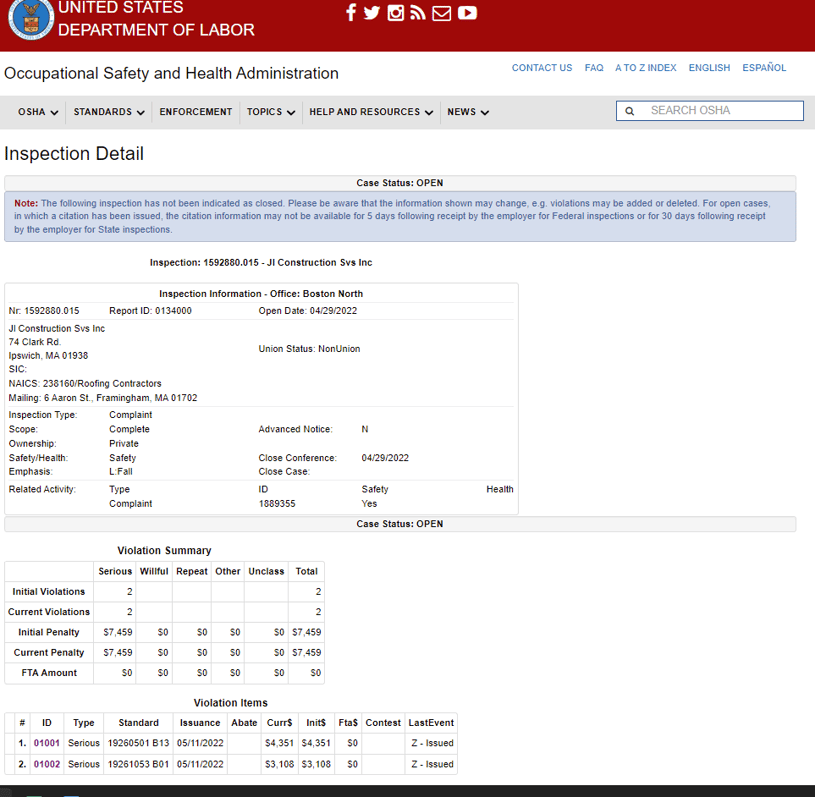
Here’s a real example from OSHA’s searchable database of inspections…
A company called JL Construction Services Inc. was inspected based on an employee complaint on April 29th and issued two citations totaling about $7459 for violating standards on Fall Protection and Ladders.
What should you do to pass a heat-illness related OSHA inspection?
There are three critical steps here:
First, avoid getting inspected by taking employee safety seriously and treat your workers with the respect and care we all deserve.
We say this because even with the NEP on heat-illness, only 40% of inspections are pre-planned by OSHA. Most OSHA inspections are due to employee complaints, an injury or death, or because other organizations or even individuals outside the company refer a complaint to OSHA. (source).
Second, for this NEP, specifically, have your heat stress safety program in place and conduct training so everyone is prepared for heat exposure. Remember, you must take into consideration all situations a worker may be exposed to heat stress.
Third, have everything squared away related to employee safety including your programs and training schedule. Everything is fair game once an OSHA compliance officer has opened an investigation. If you are targeted for a heat-illness inspection, you can still be cited for any hazard they find (source).
Have your company safety program in-place, up-to-date, and thorough. Most importantly, train your workers on all applicable OSHA standards called out in your safety program!
What should I do if I am not OSHA-compliant?
If your company is too small to have a dedicated Safety Officer or they have too much on their plate, it’s time to consider outside help.
The first thing to know about using third-party safety consulting services is understanding the true level of service they actually provide.
Many companies will ‘write’ you a safety program by placing your company name on a template they already have and charging you a high price. Does this get you compliant with OSHA… maybe, temporarily. Does it help keep your workers safe from the actual hazards your company faces… probably not. It’s checking off the boxes on a list on one of the most important aspect of running a business… people’s safety and well-being!
Really being safe requires real work. There are no shortcuts.
We at Lancaster Safety Consulting Inc. are experienced professionals who help our clients get and stay OSHA-compliant. We dig deep into your business to understand what your workers do each day. We have custom written thousands of safety programs and have trained ten of thousands of workers in courses such as OSHA 10 Hour, Fall Protection, Confined Space, and dozens of more topics.
We can come to you at your facility to train your workers all at once or we can set you up with your very own Online OSHA Training Center for many training topics.
We are real people who put in the work to help consult you on the best decisions to make your workplace safe and keep employees happy!